
Hearing Outcomes of Adenoidectomy with Myringotomy vs Grommet in Children with Otitis Media with Effusion: A Retrospective Cohort Study
Correspondence and article notes 10
ABSTRACT
Background: Otitis media with effusion (OME) is a common cause of childhood hearing impairment, usually resulting from eustachian tube dysfunction and adenoid hypertrophy. Myringotomy and myringotomy with grommet insertion, combined with adenoidectomy, are established surgical treatments for chronic OME, but evidence comparing their hearing outcomes remains mixed.
Objective: To compare postoperative hearing outcomes of adenoidectomy with myringotomy versus adenoidectomy with grommet insertion in children with otitis media with effusion (OME), treated during 2024-25.
Methods: This retrospective comparative cohort design was used by recruiting 84 children with OME from the medical record of the ENT Department of a tertiary care hospital in Abbottabad from July 2024 to June 2025. OME diagnosed children (record files) who underwent adenoidectomy and myringotomy with and without grommet Insertion were enrolled in 2 groups. Group without gromet and group B with gromet insertion. Postop Pure Tone Audiometry (PTA) data was available to compare one month and three months hearing improvements in both groups. The observation and findings of Data was analyzed on SPSS version 26.
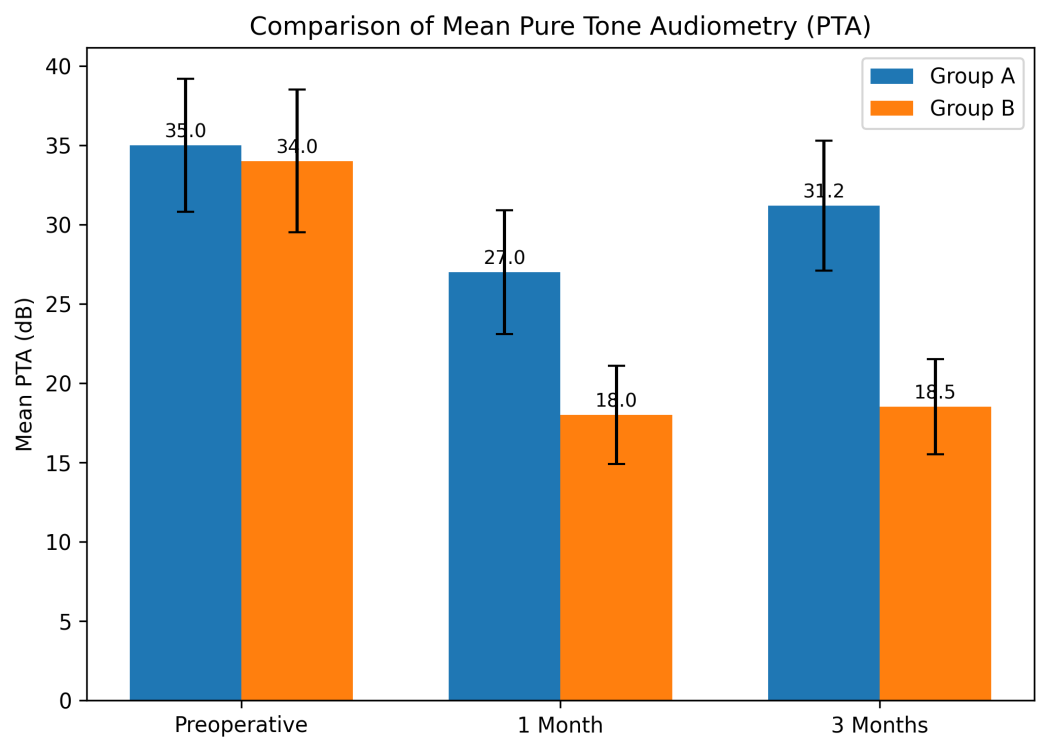
Results: The baseline average pre-operative PTA was almost similar in two groups. The average PTA results in group A were improved from 35.0 ± 4.2dB preoperatively to 27.0 ± 3.9dB after one month of operation and 31.2 ± 4.1dB after three months post operatively. Group B showed hearing improvement from 34.0 ± 4.5 dB before surgery to 18.0 ± 3.1 dB at one month and 18.5 ± 3.0 dB at three months after surgery. Group A (27) and group B (37) patients were observed to have hearing improvement of ≥10 dB at three months with adenoidectomy and myringotomy and adenoidectomy and grommet insertion, respectively.
Conclusion: Postoperative hearing improvement was better in cases where adenoidectomy with grommet insertion was performed as compared to the cases where adenoidectomy with only myringotomy was done.
Keywords: Adenoidectomy, Glue Ear, Grommet Insertion, Myringotomy, Otitis Media with Effusion, Serous Otitis Media.
INTRODUCTION
Otitis Media with Effusion (OME) also known as Serous Otitis Media or Glue Ear is the accumulation of fluid in the middle ear cavity without any infection [1]. The fluid may be mucous or sero-mucous and made up of glycoprotein mucin. This accumulation of fluid impairs the mobility of tympanic membrane thus causing conductive deafness. It is quite a common disease in children especially under five years of age. Undiagnosed OME can lead to speech delay and poor performance at school [2]. OME can resolve spontaneously or can become chronic [3]. The chronic OME can be treated with medication, which include antibiotics, Anti-inflammatory agents and nasal decongestants. The cases resistant to medical treatment can be treated by myringotomy or myringotomy with grommet insertion [2,3]. The first myringotomy was performed in 1649 [4] by Jean Riolan, a French anatomist and pathologist, who was of the opinion that deliberately making a hole in the tympanic membrane could improve hearing [4]. In 1954, Beverley Armstrong became the first to insert grommets into the tympanic membrane. [4]. It is made of gold, plastic or silicon material with a groove that sits on the edges of myringotomy [5,6].
OME is very common in children under five years of age with a prevalence of almost 30% [5]. It is the most common cause of acquired conductive hearing loss in children [7]. The risk factors to develop OME include adenoid hypertrophy, Recurrent upper respiratory tract infections and nasal allergy. These factors cause obstruction of the eustachian tube leading to negative pressure in the middle ear resulting in the accumulation of fluid in the middle ear cavity. The disease is also common in children who are breast or bottle fed in supine position. While feeding in this position the milk enters the eustachian tube causing inflammation and obstruction of the tube thus causing OME [5]. The eustachian tube in children specially under five years of age is shorter, more horizontal and patent most of the time because of the immaturity [5]. The greater prevalence of OME in children as compared to adults is because of this immaturity of eustachian tube. Hearing loss is the most common clinical feature in cases of OME which is conductive type. The older children can complain of the hearing loss but the children under five years may show inattentiveness, less social behavior, poor performance at school and speech delay. Children may present with nasal obstruction and snoring because of adenoid hypertrophy causing OME [8]. Otoscopy in OME patients show dull retracted tympanic membrane with loss of cone of light and prominent umbo. Air bubbles and air fluid levels are sometimes also visible behind the intact tympanic membrane. Pneumatic otoscopy shows immobile tympanic membrane [6,8]. The diagnosis of OME is confirmed by tympanometry which shows type B curve. Radiographic imaging(x-ray) of the postnasal space assesses adenoid size and airway obstruction. Pure tone audiogram is done to find the level of hearing loss. Untreated OME can lead to some complications like acute otitis media, adhesive otitis media, retraction pocket, cholesteatoma formation and erosion of ossicles [6].
Chronic or recurrent cases of OME need surgical management. The surgical options available are simple myringotomy to aspirate the fluid from the middle ear cavity or myringotomy and grommet insertion [5,7]. Adenoidectomy is also advised and must be performed to relieve upper airway obstruction if adenoids are enlarged enough to obstruct the airway. These children are followed up with pure tone audiograms to see the improvement in hearing postoperatively and tympanograms to see the reaccumulation of fluid in the middle ear [8]. The benefits and drawbacks of simple myringotomy and myringotomy with grommet insertion is the topic of debate and has been discussed in detail in the literature. The surgical procedure adopted depends upon the presence or absence of adenoid hypertrophy, nasal allergy, history of recurrent upper airway infections and sometimes surgeon’s preference. The objective of the present study was to compare postoperative hearing outcomes of adenoidectomy with myringotomy versus adenoidectomy with grommet insertion in children with otitis media with effusion (OME).
METHODS
This retrospective comparative cohort design over one year from July 2024 to June 2025 in the ENT Department of a tertiary care hospital, Abbottabad. A total 84 children from the age of five years to twelve years who underwent surgical treatment for OME with adenoid hypertrophy during the study period were reviewed from hospital record. All eligible cases meeting the inclusion criteria were included using consecutive record sampling; no randomization was applied. They were divided into two groups. Group A consisted of patients who underwent adenoidectomy with myringotomy and group B consisted of patients who underwent adenoidectomy with grommet Insertion. Forty two patients from each group were selected. The choice between simple myringotomy and myringotomy with grommet insertion was made intraoperatively by the operating surgeon, based on clinical judgement, the degree of adenoid hypertrophy, and middle ear findings; patients were not randomized to a treatment group. Data was stored on a structured proforma having demographic details, preoperative and postoperative tympanograms and audiograms. A standardized questionnaire was given to the parents asking them about the improvement in the hearing and nasal obstructive symptoms in their child. The children who underwent either adenoidectomy with myringotomy or adenoidectomy with grommet insertion, had type B curve on preoperative tympanogram and had conductive hearing loss of more than 25 db on preoperative audiogram during the specified period of study were included. In previous comparative studies on OME, a 25 dB threshold was consistently used to define conductive hearing loss that is clinically significant and requires surgical intervention [9].
The patients who did not have the preoperative record of tympanometry and audiometry were excluded from the study. The children who did not give adequate response on follow up audiometry, patients with Down’s Syndrome and other craniofacial abnormalities were also excluded from the study. Pure tone audiometry was performed at one month and three months after the surgery to see the hearing improvement. The follow up Tympanometry was performed in only those cases who showed recurrence of symptoms. Hearing improvement was defined a priori as a reduction of ≥10 dB in the postoperative PTA threshold at three months compared with the preoperative value. As this was a retrospective record review, the one-month and three-month postoperative PTA values used for this comparison were not obtained prospectively for the study; they were extracted from records of routine postoperative follow-up visits already documented in the patients' hospital files. Statistical Package for the Social Sciences (SPSS) version 26 was used to enter the data and analyse the findings. Quantitative variables such as age, preoperative and postoperative hearing thresholds were expressed as mean ± standard deviation. Qualitative variables such as gender and improvement of symptoms were expressed as frequencies and percentages. Independent sample t-test was applied to compare mean hearing improvement between the two groups. Paired t-test was applied to compare preoperative and postoperative hearing thresholds within each group. Chi-square test was applied to compare categorical variables between groups. A p-value of ≤0.05 was considered statistically significant. The parents or the guardians of the patients were consented before selection of the patients and group allocation. Ethical approval was obtained from the Ayub medical teaching institution Abbottabad, institutional medical and ethics review committee on 22/7/2026 vide approval code/Ref.No.EA-2026/170.
RESULTS
A total of 84 patients were selected to be included in the study, with 42 patients in each group. The mean age was 8.1 ± 2.2 years in group A and 8.3 ± 2.1 years in group B, with a male predominance in both groups (Table 1). Preoperative PTA was comparable between groups (independent-samples t-test, p=0.296), confirming similar baseline hearing status (Table 2). Postoperative PTA was significantly lower (better) in group B than in group A at both one month and three months (independent-samples t-test, p<0.001 at each time point) (Table 2 and Figure 1). Hearing improvement of ≥10 dB at three months was achieved by 27 of 42 patients (64.3%) in group A compared with 37 of 42 patients (88.1%) in group B (Table 3). Recurrence of OME, confirmed by tympanometry, occurred in 4 patients (9.5%) in Group A; one patient (2.4%) in Group B developed otorrhea, and no recurrence was observed in Group B during the three-month follow-up period.
Table No. 1. Age and Gender Distribution in Group A and B
| Variable | Group A (n=42) | Group B (n=42) |
|---|---|---|
| Mean Age (years) | 8.1 ± 2.2 | 8.3 ± 2.1 |
| Male : Female | 25 : 17 | 24 : 18 |
Table No. 2. Comparison of Pre and Post Operative Hearing Thresholds
| PTA (dB HL) | Preoperative | 1 Month | 3 Months |
|---|---|---|---|
| Group A | 35.0 ± 4.2 | 27 ± 3.9 | 31.2 ± 4.1 |
| Group B | 34.0 ± 4.5 | 18 ± 3.1 | 18.5 ± 3.0 |
Table No. 3. Postoperative Hearing Improvement in Group A and B
| Outcome | Group A (n=42) | Group B (n=42) |
|---|---|---|
| ≥10 dB Improvement | 27 (64.28%) | 37 (88.09%) |
| <10 dB Improvement | 15 (35.71%) | 05 (11.90%) |
DISCUSSION
This retrospective study compared hearing outcomes following adenoidectomy with myringotomy versus adenoidectomy with grommet insertion in 84 children with OME and adenoid hypertrophy. Although medical management has improved and may relieve the symptoms in selected cases, surgical management is the mainstay of treatment in chronic OME [10,11]. The hearing outcome was determined by pure tone audiometry in both modalities of surgical intervention. The mean age in our study was 8.1 and 8.3 years group A and B respectively which is almost similar to the age groups in the study done by Rasheed AM in which mean age was 8.48 years [12]. In our study we included the children from five to twelve years because children less than five years do not adequately respond to pure tone audiometry and we used audiometry to measure the hearing outcomes after surgery. In our study 59.5% of the children were males in group A and 57.1% in group B. This male gender predisposition in our study is also seen in studies done by Akther S et al and Basit A et al [13,14]. The average preoperative hearing threshold on PTA was 35dB in group A which improved to 27 dB at one month after the surgery and rose to 31.2 dB at three months postoperatively. In group B, the average preoperative hearing threshold was 34dB which improved to 18dB on PTA which was done one month after the surgery and 18.5dB three months postoperatively. The results of this study show that both surgical modalities lead to postoperative hearing improvement in children with chronic otitis media with effusion. However, adenoidectomy with grommet Insertion had significantly better results in terms of hearing outcome at both one month and three month postoperative period (independent sample t-test, p<0.001 at each time point), while the preoperative hearing thresholds of the two groups were not significantly different (p=0.296). This observation confirms the known fact that middle ear effusion and nasopharyngeal obstruction can be removed to enhance sound conduction. Adenoidectomy helps in the resolution of the disease by decreasing the inflammation of the nasopharyngeal tract, removing a possible source of infection, and enhancing the functioning of the eustachian tube [14]. As a result, both groups showed improvement in hearing after surgery. Adenoidectomy with myringotomy showed early postoperative hearing improvement in children. This enhancement can probably be explained by the fact that the middle ear effusion is immediately drained and the middle ear pressure is temporarily equalized. Nevertheless, this did not always last in the long run. Lack of long-term ventilation in the tympanic membrane itself can permit re-accumulation of effusion after the tympanic membrane has healed, especially in children with chronic eustachian tube dysfunction. This observation supports the idea that myringotomy has only a temporary effect in chronic otitis media with effusion. Conversely, children who received adenoidectomy and grommet insertion had more and longer-lasting hearing improvement. The ventilation tube ensures that the middle ear is aerated over a long duration, thus avoiding negative middle ear pressure and recurrence of effusion. This persistent middle ear ventilation seems to be very important at the stage of Eustachian tube immaturity in children. The high results in this group highlight the significance of long-term ventilation in the achieving long-term auditory benefit. The results of our study are in line with the results of the research done by Rasheed et al and Khan et al, who showed that the insertion of grommets had better and long-term hearing outcomes than myringotomy alone in children with otitis media with effusion, [15]. highlighting the importance of continuous middle ear aeration in the management of the disease. However, Albazee et al in his research mentioned that there are short term benefits of grommets in terms of hearing improvement but in long term follow up there is no statistical improvement in hearing after extrusion of grommets [16]. In contrary Popova et al in their study found out that there was no difference in the hearing outcome in simple myringotomy and myringotomy with grommet Insertion [17]. The evidence supporting the use of grommet insertion has also been enhanced by systematic reviews and meta-analyses. Cochrane reviews have found that ventilation tubes are effective in short to medium term hearing improvement in children with chronic otitis media with effusion [6]. Even though grommet related complications, including otorrhea and tympanosclerosis and persistent perforation, have been reported, the net benefit in terms of hearing improvement is deemed to be clinically significant in properly selected patients [18]. Adenoidectomy in itself is a significant contributory factor in both treatment groups and different studies has shown that adenoidectomy increases the efficacy of middle ear surgery by decreasing recurrence of effusion and improving eustachian tube functioning [19]. The recurrence of OME was seen in group A where 04 patients (9.5%) developed recurrent symptoms and they were managed conservatively. Only 01 patient in group B developed otorrhea and was also managed conservatively. Overall myringotomy with grommet give better results in terms of hearing outcome and recurrence of symptoms but they are associated with some complications like ear discharge, expulsion, tube obstruction and migration into the middle ear cavity. Late complications include a residual perforation and tympanosclerosis [20].
The strengths of this study include a well-defined comparison of two commonly used surgical methods within a single institution, using a standardized postoperative audiometric protocol at follow-up, which allowed direct comparison of hearing improvement between the two groups.
A major limitation of this study is its retrospective design: patients were not randomly allocated to the two treatment arms, and the choice of procedure was influenced by clinical judgement and surgeon preference, which introduces a risk of selection bias. The assessment of adenoid hypertrophy was also based on subjective clinical and radiological impression rather than a standardized objective grading system, which may have affected group allocation. The limitation our study was that we included the children aged 05 to 12 years while OME is more common in younger children. This was done because we used PTA to measure the hearing outcome and younger children could not give adequate response on PTA. Another limitation of our study was shorter follow up time, which was 03 months post operatively; standard outcome assessment for this procedure typically requires follow up of 6 to 12 months to adequately capture recurrence rate, persistent perforation and other delayed complications, and because of this we were unable to find the hearing outcomes and recurrence of OME after extrusion of grommets in group B. We recommend that future studies be conducted with randomized allocation, younger children, and longer follow up periods, especially after extrusion of grommets, to know the long term results of both modalities of treatment.
CONCLUSION
Adenoidectomy with grommet insertion is a better procedure in terms of hearing improvement than adenoidectomy with simple myringotomy when hearing evaluation is performed up to three months postoperatively in patients of chronic otitis media with effusion not responding to medical treatment. However, it is associated with some postoperative complications like otorrhea and tympanosclerosis.
Author Contributions:
SA, MIS, MR, IU:
Each author made substantial contributions to the conception and design of the study, or acquisition, analysis, and interpretation of data.
All authors were involved in drafting the manuscript or critically revising it for important intellect content.
All authors approved the final version of the manuscript to be published and agree to be accountable for all aspects of the work.
REFERENCES
- Hidaka H, Ito M, Ikeda R, Kamide Y, Kuroki H, Nakano A, et al. Clinical practice guidelines for the diagnosis and management of otitis media with effusion (OME) in children in Japan–2022 update. Auris Nasus Larynx. 2023;50(5):655-99. Doi: 10.1016/j.anl.2022.12.004.
- Chan J, Stephenson K. Diagnosis and management of middle ear disease in children. Paediatr Child Health. 2023;33(12):376-81. Doi: 10.1016/j.paed.2023.09.008.
- Iftikhar S, Jawad A, Riaz A, Umar MA, Ahmed F, Rabbani MZ. Screening of children with upper respiratory tract infection for otitis media with effusion. Ann Pak Inst Med Sci. 2023;19(2):162-6. Doi: 10.48036/apims.v19i2.858.
- Rimmer J, Giddings CE, Weir N. The History of Myringotomy and Grommets. Ear, Nose & Throat Journal. 2020;99(1_suppl):2S-7S. doi:10.1177/0145561320914438.
- Nobrega, Manoel. (2026). Otitis Media with Effusion in Children: A Review of Pathophysiology, Risk Factors, and Management. International Journal of Clinical Case Reports and Reviews. 34. 10.31579/2690-4861/1041.
- MacKeith S, Mulvaney CA, Galbraith K, Webster KE, Connolly R, Paing A, Marom T, Daniel M, Venekamp RP, Rovers MM, Schilder AG. Ventilation tubes (grommets) for otitis media with effusion (OME) in children. Cochrane Database Syst Rev. 2023 Nov 15;11(11):CD015215. doi: 10.1002/14651858.CD015215.pub2. PMID: 37965944; PMCID: PMC10646987.
- Agathiyanathan, V., Vijayasundaram, S., Govindarajan, A. et al. “Surgical Management of Pediatric Otitis Media with Effusion: Do Grommets Make a Difference?”. Indian J Otolaryngol Head Neck Surg (2026). https://doi.org/10.1007/s12070-026-06685-4
- Vanneste P, Page C. Otitis media with effusion in children: pathophysiology, diagnosis, and treatment. a review. J Otol 2019; 14(2): 33-39. DOI:10.1016/j.joto.2019.01.005
- Berkman ND, Wallace IF, Steiner MJ, et al. Otitis Media With Effusion: Comparative Effectiveness of Treatments. Agency for Healthcare Research and Quality (US), Rockville (MD); 2013. PMID: 23762917.
- Khan TM, Akram J, Muneer F, Ilyas D, Ahmed HM, Khan A, et al. Risk factors of acute otitis media among infants in a tertiary care hospital in Rawalpindi: A descriptive cross-sectional study. Int J Otorhinolaryngol Head Neck Surg. 2022;8(9):711-5. Doi: 10.18203/issn.2454 5929.ijohns20222161.
- Ahmed HE, Abdel-Hameed MM, Mohamed MA. Myringotomy with or without ventilation tube in management of children with otitis media with effusion: a comparative study. Egypt J Neck Surg Otorhinolaryngol. 2022;8(1):17-23. Doi: 10.21608/ejnso.2022.222803.
- Rasheed AM, Abbas AM, Hilal SA, Homadi NJ. Adenoidectomy and Endoscopic Myringotomy with and without ventilation tube insertion for Treatment of Otitis Media with Effusion in 6-12 years old Children https://doi.org/10.5935/0946-5448.20230005
- Akhtar S, Gul U, Jawaid A, Azam K, Niazi MSB, Najam A. Myringotomy for The Treatment of Otitis Media with Effusion; A Comparison in the Outcome with and Without Grommet Insertion. Pak Armed Forces Med J 2021; 71(Suppl-3): S521-525. Doi: https://doi.org/10.51253/pafmj.v1i1.7920
- Basit A, Noor S, Ahmad SA, Noor N, Maryam R, Basil AM. Otitis media with effusion and hearing outcomes - Myringotomy vs myringotomy and tympanostomy: A comparative study. World J Otorhinolaryngol 2025; 12(1): 109355 [DOI: 10.5319/wjo.v12.i1.109355]
- Khan MA , Alamgir A , Musharaf M. Comparison of Outcome of Myringotomy Alone with Myringotomy and Tympanostomy Tube (Grommet) in Otitis Media with Effusion (OME). JRMC [Internet]. 2018 Jun. 30 [cited 2026 Jul. 5];22(2). Available from: https://mail.journalrmc.com/index.php/JRMC/article/view/886.
- Albazee E et al. Adenoidectomy with tympanostomy or with myringotomy alone: A systematic review of pediatric randomized controlled trials. International Journal of Pediatric Otorhinolaryngology, Vol 202, Mar 2026. https://doi.org/10.1016/j.ijporl.2026.112718
- Popova D, Varbanova S, Popov TM. Comparison between myringotomy and tympanostomy tubes in combination with adenoidectomy in 3–7-year-old children with otitis media with effusion. International Journal of Pediatric Otorhinolaryngology, Volume 74, Issue 7, 2010, Pages 777-80, https://doi.org/10.1016/j.ijporl.2010.03.054.
- Brown C, Behar P. Factors affecting persistent tympanic membrane perforation after tympanostomy tube removal in children. International Journal of Pediatric Otorhinolaryngology. Volume 130, 2020, 109779, ISSN 0165-5876, https://doi.org/10.1016/j.ijporl.2019.109779.
- Valenta, T., Skoloudik, L., Nema, K. et al. The Efficacy of Adenoidectomy on Otitis Media with Effusion According to the Age of Child. Eur Arch Otorhinolaryngol 283, 811–819 (2026). https://doi.org/10.1007/s00405-025-09750-w
- Alvi SA, Jones JW, Porter P, Perryman M, Nelson K, Francis CL, Larsen CG. Steroid Versus Antibiotic Drops in the Prevention of Postoperative Myringotomy Tube Complications. Ann Otol Rhinol Laryngol. 2018 Jul;127(7):445-449doi: 10.1177/0003489418776669. Epub 2018 May 28. PMID: 29807438.