Abstract
Background: Chronic hepatitis B and C affect millions globally, with Pakistan facing a significant burden. These conditions often lead to depression, exacerbating the decline in quality of life.
Objective: To assess severity of depression in chronic hepatitis B and C patients and its effect on quality of life in Pakistani population.
Method: This cross-sectional study was conducted at Centre for Liver Diseases, Holy Family Hospital, Rawalpindi from 1st January to 30th June 2023. The inclusion criteria were chronic hepatitis B and C patients of both male and female gender, aged between 18-60 years, taking antiviral therapy. Total 90 patients fulfilling inclusion criteria were enrolled after informed consent. Demographic data was obtained by using a self-devised proforma. Depression was assessed by Beck Depression Inventory-II (BDI-II) and QOL by WHOQOL-BREF. Data was analyzed in SPSS 25 using one-way ANOVA and Chi-square tests (p ≤ 0.05).
Results: The sample comprised of 90 patients with chronic hepatitis, 31 (34.4%) with HBV and 59 (65.6%) with HCV; 43 men (47.8%) and 47 women (52.2%), with a mean age of 35.7 ± 5.8 years. Mean BDI (II) score was 29.7 ± 10.7. Mean WHOQOL-BREF was 74.74 ± 17.32 and declined significantly with greater depression severity (p < 0.05). Hepatitis C patients reported higher depression rates and lower QOL than those with hepatitis B.
Conclusion: In conclusion, depression is very common in chronic hepatitis patients and markedly reduces quality of life. Integrating mental-health screening and interventions into hepatology care is essential.
Keywords: Chronic Hepatitis; Depression; Quality of Life; Pakistan
Introduction
Viral hepatitis has long posed a serious threat to human health, contributing significantly to both acute and chronic illness-related morbidity and mortality. Historical records trace its epidemic presence as far back as 5,000 years ago in China, with Hippocrates also describing jaundice-like illness in the fifth century BC on the Greek island of Thassos 1. World Health Organization (WHO) recently reported that about 257 million people suffer from chronic hepatitis B (CHB), and 71 million with hepatitis C (CHC) worldwide. In Pakistan alone, nearly 12 million individuals are affected by either hepatitis B virus (HBV) or C virus (HCV), reflecting a major public health burden 2. The burden of hepatitis B and C is disproportionately higher in low- and middle-income countries (LMICs), where access to diagnostic testing, antiviral treatment, and effective infection control remains limited. Pakistan ranks among the top four countries globally with the highest prevalence of viral hepatitis. CHB and CHC infections can lead to liver cirrhosis and, eventually, hepatocellular carcinoma, posing serious long-term health risks 3.
About half of individuals with hepatitis B or C develop comorbid psychiatric conditions 4. In a recent study, 37.5% of chronic HBV patients reported depressive symptoms 5. The higher risk of depression among patients with CHB is multifactorial including the unpredictable disease course, life-long illness, side-effects of antiviral treatment, fear of progression or transmission, financial strain, job loss, sexual restrictions, emotional distress, social stigma, social isolation, presence of medical comorbidities and concerns about mortality etc. These factors contribute to the onset or worsening of depression, which has been consistently linked to a decline in quality of life 4, 6, 7. Depression affects an estimated 20% to 50% of individuals with HCV infection and is a key contributor to their diminished well-being. In many cases, depressive symptoms emerge as a psychological reaction to the physical and social consequences of chronic illness. Beyond hepatic damage, systemic inflammation associated with HCV disrupts the hypothalamic-pituitary-adrenal (HPA) axis, further increasing susceptibility to depression 8.
Depression remains one of the most pressing global health challenges, currently affecting 350 million individuals, which constitutes approximately 4.4% of the global population. By 2030, it’s expected to emerge as the primary source of global disease burden 9. The WHO defines health as 'a state of complete physical, mental and social well-being, and not merely the absence of disease or infirmity’. Quality of life (QoL) includes physical, mental, emotional and social functioning domains 10. Both hepatitis B and C infections significantly affect psychological and social well-being contributing to a marked decline in quality of life 5, 8. Emerging evidence indicates that patients with hepatitis C experience a more pronounced decline in QoL compared to those with hepatitis B 8. Early identification of psychiatric symptoms and timely intervention are essential for improving the QoL of individuals living with chronic hepatitis. In this context, our study was designed to examine the relationship between chronic hepatitis and depression severity, and its impact on QoL of Pakistani population.
Method
This cross-sectional study was conducted at Center for Liver Diseases, Holy Family Hospital, Rawalpindi from 1st January to 30th June 2023 after approval from Research Evaluation Unit CPSP (Ref No: CPSP/REU/PSY-2019-126-725 dated 05-08-21). The sample size was determined to be 90 patients, using the World Health Organization (WHO) sample size calculator, with a confidence level of 95%, an anticipated population proportion of 68%, and an absolute precision of 10%. Total 90 patients fulfilling inclusion criteria were enrolled by non-probability consecutive sampling technique after informed consent. The inclusion criteria were patients with chronic HBV/HCV (≥ 6 months) on antiviral therapy, of both male and female gender, aged between 18-60 years. The exclusion criteria were patients with prior history of depression predating hepatitis diagnosis, cognitive impairment, non-viral hepatitis. The severity of depressive symptoms was assessed by the Beck Depression Inventory version II (BDI-II). BDI-II is a commonly used self-report measure to assess severity of depressive symptoms, comprised of 21 items rated on a 4-point Likert scale. Total score ranges from 0 to 63, and higher score indicates higher symptom severity 11. To evaluate QoL, we used the World Health Organization Quality of Life Assessment Instrument, Short Version (WHOQOL-BREF), a 26-item questionnaire, consists of four domains: physical health (seven items), psychological health (six items), social relationships (three items), and environment (eight items) 12.
Data was analyzed using SPSS Version 25. The Quantitative variables (e.g., age) were presented as means and standard deviations. The Qualitative variables (e.g., gender, education, occupation) were reported as frequencies and percentages. One-Way ANOVA was applied to compare WHOQOL-BREF scores across depression severity levels, and Chi-square tests were used to explore associations between hepatitis type and depression severity, and between QoL categories and depression severity. A p-value ≤ 0.05 was considered statistically significant.
Results
90 patients fulfilling the selection criteria were enrolled to determine the severity of depression in patients with CHB or CHC and its effect on QoL. Out of 90 patients, 31 (34.4%) were diagnosed with Hepatitis B, and 59 (65.6%) with Hepatitis C. The mean age was 35.72 ± 5.80 years. Gender distribution showed that 43 (47.8%) were males whereas 47 (52.2%) were females. Marital status showed that 11 (12.2%) were single, 71 (78.9%) were married, 4 (4.4%) were divorced and 4 (4.4%) were widowed. Educational background showed that 30 (33.3%) were illiterate, 18 (20%) did primary, 14 (15.6%) did middle, 24 (26.7%) did matric and 4 (4.4%) had acquired higher education. Employment status showed that 32 (35.6%) were unemployed and 58 (64.4%) were employed; 62 (68.9%) resided in urban areas while 28 (31.1%) lived in rural areas.
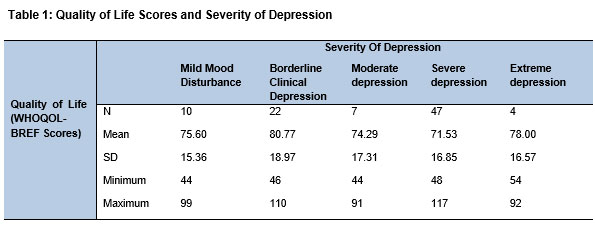
The Mean BDI-II score was 29.72 ± 10.74; 10 (11.1%) exhibited mild mood disturbances, 22 (24.4%) were classified with borderline clinical depression, 7 (7.8%) experienced moderate depression, 47 (52.2%) suffered from severe depression, and 4 (4.4%) reported an extreme level of depression. Their mean WHOQOL-BREF score was 74.74 ± 17.32; with mild mood disturbance 75.60 ± 15.36, with borderline clinical depression 80.77 ± 18.97, with moderate depression 74.29 ± 17.31, with severe depression 71.53 ± 16.85, and with extreme depression 78 ± 16.57. (Table I).
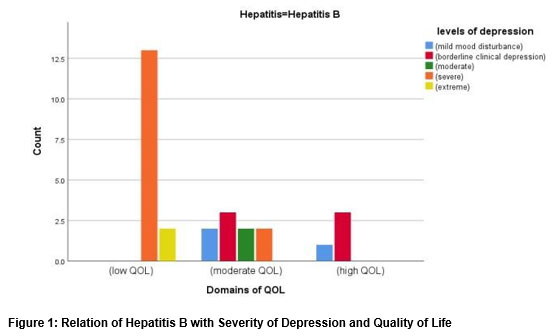
Hepatitis B patients who had low WHOQOL-BREF scores included 13 (46.4%) cases of severe depression and 2 (7.1%) cases of extreme depression. Hepatitis B patients who scored moderately on WHOQOL-BREF had 2 (7.1%) cases of mild mood disturbance, 3 (10.7%) cases of borderline clinical depression, 2 (7.1%) cases of moderate depression, and 2 (7.1%) cases of severe depression. Hepatitis B patients who had high WHOQOL-BREF scores included 1 (3.6%) case of mild mood disturbance and 3 (10.7%) cases of borderline clinical depression. (Figure I).
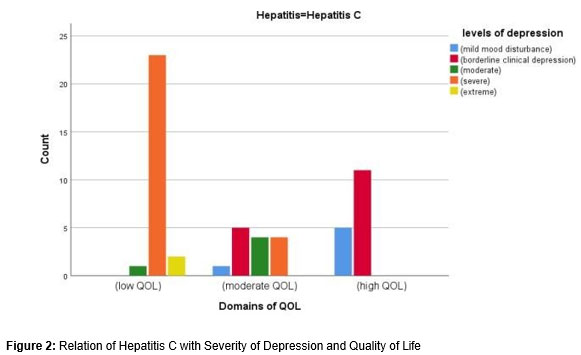
Hepatitis C patients who had low WHOQOL-BREF scores included 1 (1.8%) case of moderate depression, 23 (41.1%) cases of severe depression and 2 (3.6%) cases of extreme depression. Hepatitis C patients who scored moderately on WHOQOL-BREF had 1 (1.8%) case of mild mood disturbance, 5 (8.9%) cases of borderline clinical depression, 4 (7.1%) cases of moderate depression and 4 (7.1%) cases of severe depression. Hepatitis C patients who had high WHOQOL-BREF scores included 5 (8.9%) cases of mild mood disturbance and 11 (19.6%) cases of borderline clinical depression. (Figure II)
The data was also stratified and analyzed for the age, gender, marital status, education, employment, and place of residence of the patients.
The results showed that hepatitis C patients reported higher depression rates and lower QoL than those with hepatitis B. Patients with severe depression had significantly lower WHOQOL-BREF scores than those with milder forms of depression (F = 8.37, p < 0.001) 13.
Discussion
In this study, we determined the severity of depression in CHB and CHC patients and how depression severity affects their QoL. A total of 90 patients were selected, out of those 31 (34.4%) were diagnosed with Hepatitis B, and 59 (65.6%) with Hepatitis C. It was found that hepatitis C patients reported higher depression rates and lower QoL than those with hepatitis B matching the findings of Faccioli and his colleagues 8. Our data showed that chronic hepatitis patients with more severe depressive symptoms reported significantly lower QoL, supporting an inverse relationship between depression and QoL, consistent with the international researches. Li et al. identified depression as one of the strongest predictors of low QoL across all domains – physical, psychological, social, and environmental – in a large study of CHB patients in China 13. Similarly, another study demonstrated that greater depression severity is strongly associated with declines in mental health and social functioning among patients with CHC 14.
Interestingly, female patients in our study reported comparatively better QoL in the social and psychological domains than males, despite having a higher baseline risk for depression. This aligns with findings by Rahman et al., who observed that although women with HBV in Bangladesh exhibited higher depression rates, their stronger family and community support appeared to buffer the impact on overall QoL 7. Moreover, in our study, divorced and widowed patients reported higher depression scores, likely reflecting the effects of social isolation consistent with findings from a hepatitis C cohort in Serbia 14. Similarly, another study has shown that divorced or widowed individuals tend to have lower physical functioning and emotional well-being compared to their married or single counterparts 10.
Another significant finding was the strong association between severe depression and reduced physical activity. In our cohort, patients with higher depression severity consistently reported lower scores in the physical health domain, suggesting that disease-related fatigue and malaise limit mobility, which in turn exacerbates low mood starting a vicious cycle that worsens QoL. This aligns with the result of a longitudinal study, involving over 11,000 adults, confirming bidirectional relationship between physical activity and depression over time. Lower levels of physical activity exacerbate depressive symptoms, while depression itself doubles the likelihood of physical inactivity 15. Whereas regular physical activity can play a protective role against depression by reducing the HPA axis reactivity, increasing levels of noradrenalin and serotonin, brain-derived neurotrophic factor levels, and reducing inflammation and microvascular dysfunction 10.
It was also noted that socioeconomic disadvantage – such as older age, limited education, unemployment, and rural residence – is associated with poorer quality of life, consistent with previous studies from both Pakistan and the United States 16. Access to hepatology and mental health services remains limited in rural Pakistan, leading to delayed diagnosis and treatment. Multiple studies have identified key barriers including stigma, limited services, financial constraints, lack of awareness, reliance on traditional healers, and poor social support – factors that collectively worsen both physical and psychological outcomes 17, 18.
Our findings emphasize the importance of integrating psychosocial care routine depression screening, streamlined psychiatric referral pathways, tailored psychosocial support, lifestyle counselling into hepatology clinics as essential component of comprehensive care for patients with chronic hepatitis, as suggested by Li et al. 13.
However, this study has a few limitations that warrant acknowledgment. It was conducted at one center and can’t be generalized to the widespread Pakistani population with chronic hepatitis. As a cross-sectional design, it cannot establish causality or identify underlying contributors to severe depression and reduced quality of life. Additionally, reliance on self-report scales incurs possible response bias. Future multi-center, longitudinal studies using objective clinical assessments are needed to better understand the determinants of depression and impaired quality of life in chronic hepatitis patients across Pakistan.
Conclusion
This study confirms that depression is highly common among chronic hepatitis B and C patients and is inversely associated with quality of life. Our findings from a Pakistani cohort align with international evidence linking chronic liver disease to elevated depression and reduced QoL. We recommend a holistic, multidisciplinary approach that addresses both physical and mental health – particularly in underserved rural communities of Pakistan to improve clinical outcomes and overall quality of life of hepatitis patients.
References
- Castaneda D, Gonzalez AJ, Alomari M, Tandon K, Zervos XB. From hepatitis A to E: a critical review of viral hepatitis. World J Gastroenterol. 2021;27(16):1691–715. https://doi.org/10.3748/wjg.v27.i16.1691
- Waheed MS. Prevention and control of hepatitis [Internet]. World Health Organization - Regional Office for the Eastern Mediterranean. Available from: https://www.emro.who.int/pak/programmes/prevention-a-control-of-hepatitis.html
- Tesfa Sewunet Alamneh, Walker JG, Lim AG, Alam E, Hamid S, Foster GR, et al. Changes in the prevalence of hepatitis B and C viral infections in Sindh province, Pakistan. J Viral Hepat. 2024;31(11):645–56. https://doi.org/10.1111/jvh.13986
- Low CE, Ge G, Yeong TJJM, Rana S, Loke S, Kow WC, et al. Burden of psychological symptoms and disorders among individuals with hepatitis B: a systematic review and meta-analysis. Front Psychiatry. 2025;16. https://doi.org/10.3389/fpsyt.2025.1546545
- Qin Z, Liu Y, Liu Y, Yang A, Zhang R, Zhang K, et al. Association between resolved hepatitis B virus infection and depression in American adults: a cross-sectional study. Sci Rep. 2025;15(1). https://doi.org/10.1038/s41598-025-99864-2
- Zhu L, Lu W, Gamoso W, Tan Y, Johnson C, Ma GX. The association between modifiable lifestyle behaviors and depression among Asian Americans with chronic hepatitis B. Brain Sci. 2022;12(2):188. https://doi.org/10.3390/brainsci12020188
- Rahman M, Noor-E-Alam SM, Rahim MA, Das DC, Ahmed F, Mamun AA, et al. Depression among patients with chronic hepatitis B: a cross-sectional study. Euroasian J Hepatogastroenterol. 2023;13(2):79–83. https://doi.org/10.5005/jp-journals-10018-1406
- Faccioli J, Nardelli S, Gioia S, Riggio O, Ridola L. Neurological and psychiatric effects of hepatitis C virus infection. World J Gastroenterol. 2021;27(29):4846–61. https://doi.org/10.3748/wjg.v27.i29.4846
- Gianfredi V, Schaper NC, Odone A, Signorelli C, Amerio A, Eussen SJPM, et al. Daily patterns of physical activity and depression: the Maastricht Study. Scand J Med Sci Sports. 2022;32(12):1768–80. https://doi.org/10.1111/sms.14235
- Ivanova O, Sineke T, Wenzel R, Siyame E, Lalashowi J, Bakuli A, et al. Health-related quality of life and psychological distress among adults in Tanzania. Arch Public Health. 2022;80(1). https://doi.org/10.1186/s13690-022-00899-y
- Lien IA, Bolstad I, Lien L, Bramness JG. Screening for depression in patients with alcohol use disorder. Psychiatry Res. 2022;308:114363. https://doi.org/10.1016/j.psychres.2021.114363
- Mahmoud A, Mohamed MA, Hassan AM, Badran EM. Impaired health-related quality of life in hepatitis B virus carriers. Egypt Liver J. 2025;15(1). https://doi.org/10.1186/s43066-025-00422-2
- Li G, Wang G, Hsu FC, Xu J, Pei X, Zhao B, et al. Effects of depression and stigma on quality of life among chronic hepatitis B patients. Am J Trop Med Hyg. 2020;102(5):988–94. https://doi.org/10.4269/ajtmh.19-0007
- Kačavenda-Babović D. Depression, anxiety and quality of life in patients with chronic hepatitis C virus infection. Acta Clin Croat. 2021. https://doi.org/10.20471/acc.2021.60.04.03
- Yamaguchi R, Makino K, Katayama O, Yamagiwa D, Shimada H. Physical inactivity and depressive symptoms in older adults. J Nutr Health Aging. 2024;29(3):100452. https://doi.org/10.1016/j.jnha.2024.100452
- Matos Rivera L, Andrews S, Eswaran S. Sociodemographic risk factors for depression in chronic liver disease. Clin Liver Dis. 2022. https://doi.org/10.1002/cld.1208
- Riaz K, Sajid M, Ishtiaq M, Amin H. Barriers and access to mental healthcare in rural Pakistan. J Popul Ther Clin Pharmacol. 2023;31(9):2892–902. https://doi.org/10.53555/mhznzr83
- Choudhry FR, Khan N, Munawar K. Barriers and facilitators to mental health care in Pakistan. Int J Ment Health. 2021;52(2):1–39. https://doi.org/10.1080/00207411.2021.1941563