Abstract
Background: Breast abscess is a frequent complication of lactational mastitis particularly in low-resource settings where the priority is continuing effective breastfeeding, optimizing the management course, while maintaining satisfactory cosmetic outcomes.
Objective: To compare the effectiveness of ultrasound-guided needle aspiration (USG-NA) with incision and drainage (I&D) for breast abscess with respect to short-term recurrence and overall clinical outcomes.
Method: This single-centre quasi-experimental study was conducted at Ayub Teaching Hospital from August 2022 to June 2023. Ethical approval was obtained and all participants provided written informed consent. Sixty women aged 20–60 years with a first episode of breast abscess (>1 cm) were enrolled and allocated equally to ultrasound-guided needle aspiration (USG-NA; n=30) or conventional incision and drainage (I&D; n=30) in a 1:1 ratio based on clinical indication and patient consent. Empirical antibiotics were administered to both groups and modified based on culture results. The primary outcome measure was abscess recurrence at two weeks, confirmed either clinically or through ultrasonography. Secondary analyses stratified outcomes by age, residence, abscess size, and lactation status.
Results: The mean age was 25.45±3.83 years. Overall recurrence was 21.7% (13/60). Recurrence was observed in 3 (10.0%) after aspiration versus 10 (33.3%) after incision and drainage; (p = 0.028). Subgroup analysis showed significantly lower recurrence with aspiration among patients ≤30 years (p=0.035), urban residents (p=0.021), and abscesses ≤2 cm (p=0.009). No major procedure-related adverse events were reported. Breastfeeding continuation was maintained in most patients post procedure.
Conclusion: USG-NA reduced short-term recurrence versus I&D, particularly in younger patients, urban residents, and smaller abscesses. It is safe, minimally invasive, preserves tissue, and supports continued breastfeeding. Trials with longer follow-up are recommended.
Keywords: Breast disease, Abscess, Drainage, Fine needle aspiration, Ultrasonography, Recurrence.
Introduction
Breast abscess is a common surgical condition that predominantly affects women during the reproductive and lactational periods 1. It is the localized accumulation of purulent material within the breast parenchyma that frequently results as a complication of mastitis. The incidence varies across regions, but lactating women are most frequently affected, with reported rates of mastitis ranging between 1% and 33%, of which 4.6% to 11% may progress to abscess formation 2. Incidence of breast abscess in women of Pakistan is reported to be approximately 10.2% 3. Predisposing factors include nipple trauma due to suckling, milk stasis from incomplete emptying of the breast, poor breastfeeding technique, and colonization by pathogenic bacteria such as Staphylococcus aureus 4. In resource-limited settings where access to early medical care and breastfeeding support services is often limited, handling these risk factors is of extreme importance. Early diagnosis and prompt treatment play a vital role in reducing morbidity, recurrence, and allowing continuation of breastfeeding 4.
In the management of breast abscess, incision and drainage (I&D) has been used for decades as the gold standard 5. It allows effective drainage of pus and ensures complete breakdown of loculated collections. However, the downside is that the procedure is invasive, painful, and requires anaesthesia (local or general). Disadvantages include prolonged wound healing, the need for frequent dressing changes, an increased risk of secondary infection, and unsatisfactory cosmetic outcomes due to scarring. Importantly, I&D often requires hospitalization and temporary cessation of breastfeeding, which have adverse psychological and nutritional effects on both mother and child. In recent decades, minimally invasive surgery has emerged, where diagnostic imaging provides better treatment outcomes. For breast abscess, ultrasound-guided needle aspiration (USG-NA), often repeated over several sittings, has been adopted by surgeons as a less invasive option 6. When carried out under ultrasound guidance, aspiration provides several clear benefits. It allows the surgeon to see the abscess cavity in real time, ensuring better drainage of pus. The procedure is less painful, promotes faster recovery, and helps preserve the natural appearance of the breast 7. Moreover, patients reported greater satisfaction regarding shorter hospital stay, faster recovery, and the ability to continue breastfeeding safely during treatment 5.
Despite these advantages, the role of aspiration is still debated among surgeons. Literature has reported treatment recurrence as the primary problem in this approach. One study reported a recurrence rate of 23.3% among patients treated with I&D, compared with 70.0% in those managed with USG-NA, a statistically significant difference (p = 0.001) 8. Contradictory statements exist in another study that reported no recurrence in USG-NA, whereas a recurrence rate of 3.3% was noted in patients treated with I&D 9. Therefore, the absence of standardized treatment guidelines continues to fuel debate over the most effective management approach for breast abscesses.
Given these factors, a comparative assessment of I&D versus USG-NA is warranted for the optimal management of breast abscesses. A properly designed study can provide evidence to guide clinicians in selecting the most effective and least morbid option. The present study was therefore undertaken to generate institution-specific evidence by comparing effectiveness of USG-NA and conventional I&D for the management of breast abscess, focusing on recurrence, treatment outcomes, and practical applicability in routine clinical practice.
Method
A Non-Randomized Trial was conducted in the Department of Surgery at Ayub Teaching Hospital Abbottabad from 29 August, 2022 to 1 June, 2023. Written informed consent was obtained from all participants prior to enrollment, retaining the right to withdraw at any time without providing a reason. The study was approved by the Institutional Research and Ethical Review Board (IREB) of Ayub Teaching Hospital (Ref: RC-2022/EA-01/122) on 29 August 2022.
Women aged 20–60 years presenting with a first episode of breast abscess, whether lactating or non-lactating, confirmed clinically or by ultrasonography were included. Eligible participants had isolated breast abscesses measuring >1 cm in diameter on ultrasonography and were appropriate for either USG-NA or conventional I&D without extensive skin involvement. Exclusion criteria comprised recurrent abscess in the same breast, multifocal or multiloculated abscesses with extensive septations, impending skin necrosis requiring urgent surgical intervention, suspected or confirmed breast malignancy, active pulmonary tuberculosis or tuberculous mastitis, and tuberculous cervical lymphadenitis. Patients with comorbid conditions likely to affect healing or infection control, such as uncontrolled diabetes mellitus, immunocompromised state, chronic renal failure (serum creatinine >1.5 mg/dL), or coagulopathy (INR >1.5), were excluded. Women subjected to prior invasive treatment for the current abscess, those with systemic sepsis requiring hospitalization, or those unwilling to provide informed consent were also excluded.
Patients underwent either conventional I&D, performed through a radial incision over the point of maximal fluctuance with evacuation of pus, disruption of loculations, irrigation of the cavity with normal saline, and placement of sterile gauze packing for continued drainage; or USG-NA using a wide-bore needle under aseptic conditions. All procedures were performed by the same surgical team.
Using OpenEpi, the sample size was determined to compare two independent proportions. The recurrence rate is 33.3% for I&D and 66.7% for needle aspiration 7. With a two-sided α = 0.05 and 80% power, the minimum required sample was 21 per group. To compensate for possible loss to follow-up and to enhance statistical precision, 30 patients were enrolled in each group, giving a total sample of 60.
Eligible participants were non-randomly allocated in a 1:1 ratio to one of two treatment arms: Group A (USG-NA) and Group B (I&D). Patients in Group A underwent ultrasound-guided needle aspiration (USG-NA). Repeat aspiration was performed when residual collection persisted on ultrasonography, with a maximum of three sessions conducted at 48–72 hour intervals until clinical and radiological resolution, whereas those in Group B were treated with I&D. Both groups received empirical antibiotic therapy consisting of ciprofloxacin 500 mg twice daily and Danzen DS twice daily for 10 days, in accordance with local antimicrobial prevalence, resistance patterns, and institutional guidelines. Culture and sensitivity was performed for all patients and further antimicrobial therapy was adjusted according to the results. Patients were assessed clinically and by ultrasonography and followed for recurrence and procedure-related outcomes. All participants were followed for two weeks after treatment, and recurrence was classified as present or absent on the basis of clinical or ultrasonographic evidence.
Data regarding age, marital status, lactation status, duration and size of abscess, body mass index (BMI), presence of diabetes mellitus, and treatment outcome (satisfactory: complete resolution of pain and abscess, no recurrence and normal breast morphology; unsatisfactory: persistent pain and abscess, recurrence and significant complications) were systematically recorded.
Data analysis was done via SPSS version 23.0. Continuous data are summarized as mean ± SD or median (IQR), and categorical data as frequencies and percentages. The Chi-square test was applied to compare recurrence between the two groups. Confounders like age, marital status, lactation status, duration of abscess, abscess size, and obesity were handled through stratification. Chi-square tests were used to find associations with treatment outcomes. A p-value ≤ 0.05 was considered statistically significant.
Results
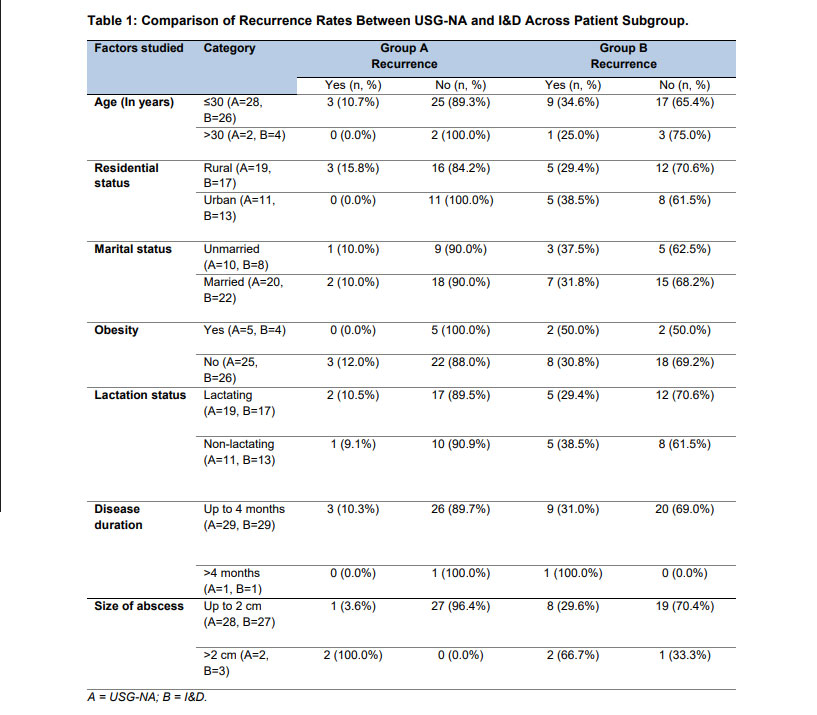
Sixty patients who met the predefined inclusion criteria were non-randomly allocated in equal proportions to either of the two treatment groups: Group A (USG-NA, n = 30) or Group B (I&D, n = 30), as mentioned in Table 1. All participants completed the scheduled two-week follow-up and were considered eligible for inclusion in the final data analysis.
The mean age of the cohort was 25.45 ± 3.83 years (range 21–37); group means were 25.50 ± 3.54 years (Group A) and 25.40 ± 4.17 years (Group B) (p = 0.921). The majority of patients were ≤30 years (90%). Thirty-six patients (60.0%) resided in rural areas and 24 (40.0%) in urban areas. No cases of diabetes were reported in either group. Eighteen patients (30.0%) were unmarried and 42 (70.0%) were married. Mean BMI was 24.97 ± 1.88 kg/m²; while 9 patients (15.0%) had a BMI >25. Thirty-six patients (60.0%) were lactating. The mean duration of abscess was 3.31 ± 0.62 months, with 96.7% having duration ≤4 months. The mean abscess diameter was 1.21 ± 0.21 cm, and 91.7% had abscess size ≤2 cm. No patient in either group had diabetes, and there were no reports of major procedure-related adverse events.
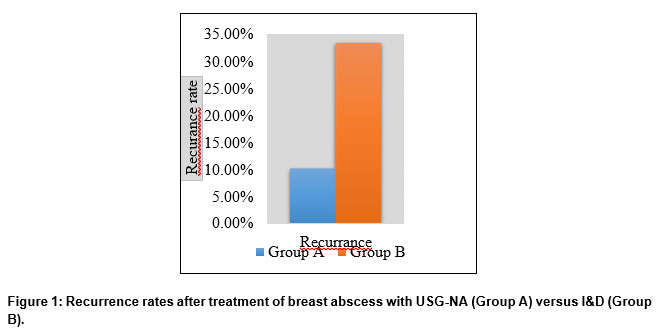
Overall recurrence was observed in 13 (21.7%) patients as shown in Figure 1. Recurrence occurred in 10.0% of patients in the USG-NA group (Group A) compared with 33.3% in the I&D group (Group B), as shown in Figure 1. This difference was statistically significant (p = 0.028), indicating a lower short-term recurrence rate following USG-NA. The difference remained evident in several clinically relevant subgroups (younger age, urban residence, and smaller abscess size) as demonstrated in Table 1. When data were stratified by abscess size, patients with abscesses measuring ≤2 cm showed differences in recurrence, indicating that abscess size may influence the effectiveness of the treatment modality. Other variables such as marital status, obesity, lactation status, and disease duration did not reach statistical significance. USG-NA emerged as an effective, minimally invasive, and cosmetically favorable option for managing breast abscesses.
Discussion
Breast abscess is a frequently painful, morbid condition that affects women during the post-partum period and arises commonly due to inadequately treated mastitis. The contemporary management of breast abscesses entails a multifaceted approach, including systemic antimicrobial regimens, USG-NA, and the traditionally invasive approach of I&D.
To reconcile and address the present discordance in the existing literature, this study was undertaken to compare the effectiveness and clinical results of USG-NA versus the invasive approach of I&D employed in the therapeutic stratagem of breast abscesses at the Ayub Teaching Hospital, Abbottabad. This study enrolled a group of 60 patients clinically diagnosed with breast abscess. The mean age reported was 25.50 years in the USG-NA group and 25.40 years in the I&D group, which aligns with the data reported by studies provided by Francisco and Prashanth et al 10. Majority of the patients were from younger age group, ≤30 years. Sixty percent of the study population belonged to rural areas and had no history of diabetes in either group. The potential factors attributed to this include delayed healthcare access to rural residents, poor hygiene, socioeconomic barriers, and lack of postnatal follow-up 11.
Seventy percent of women were married, and the mean BMI was 24.97 ± 1.88 kg/m². 15.0% of women were found to be obese, a critical risk factor for the progression of breast abscesses and inflammation via various mechanisms 12. Sixty percent of the women were lactating, which is significant as nursing women are highly vulnerable to breast abscesses, often considered a sequel of untreated lactational mastitis 13. The trauma caused by a baby’s teeth or cracked nipple serves as a gateway for the entry of Staphylococcus aureus, and milk provides an optimal growth medium for bacterial proliferation, leading to infection with abscess formation 14. These results align with data reported by Toomey et al, who documented that approximately 4–11% of women with breast abscess were lactating mothers 15.
Our primary finding was a statistically significant (p = 0.028) lower recurrence rate of breast abscesses after USG-NA (10%) compared to I&D (33.3%) over a follow-up period of two weeks. These findings are in close alignment with recent evidence provided by Totadri et al 16, who reported no recurrent cases in USG-NA in comparison with the I&D group which found a recurrence of 28%. This superiority warrants discussion for possible underlying causes, including preservation of tissue integrity due to fine needle placement in the localized area, causing less trauma, faster healing, less pain, and complete evacuation of pus with ultrasound guidance 16, 15. Conversely, the higher recurrence (33.3%) with the I&D approach can be attributed to the large open wound that prolongs healing, causes more significant tissue disruption, damages breast parenchyma and lactiferous ducts, and leads to difficulty in breastfeeding with milk stasis, contributing to recurrence 17. Our results, however, contradict findings of Javed et al, who observed a 70% recurrence rate following USG-NA compared to I&D. This discrepancy can be explained by the fact that they performed blind aspiration without ultrasound guidance, likely leading to inadequate localization of the abscess and consequently higher recurrence rates 8.
Based on subgroup analysis, stratified according to age group ≤30 years, recurrence was significantly lower (p = 0.035) between the two treatment groups. With age, the risk of ductal ectasia, fat necrosis, diabetes, immunodeficiency, and smoking increases, leading to recurrence of breast abscess 18. Similarly, a lower incidence of recurrence was reported among urban residents with USG-NA compared to I&D (p = 0.021), stemming from better access to health facilities and awareness among residents.
Stratification based on abscess size revealed that USG-NA is more efficacious for abscesses ≤2 cm, with recurrence of 3.6% in Group A compared to 29.6% in Group B. These findings align with existing literature 19. For larger complex abscesses involving multiple compartments, the standard treatment remains I&D, which allows complete evacuation of pus from the abscess cavity 19, 20. Further subgroup analysis based on marital status, lactation status, obesity, and disease duration revealed non-significant differences statistically between the treatment groups, as all p-values exceeded 0.05, indicating no meaningful association between treatment and outcomes.
The key strength of this non-randomized controlled design is its systematic data collection and prospective design, which minimizes bias. Further, the method of allocation of patients into different groups and predefined inclusion and exclusion criteria enhances the robustness of the study. However, crucial limitations exist. It was a single-centered study with a short follow-up duration (14 days) for the primary outcome of recurrence, which in the future should be extended to 6 months. These limitations highlight the need for future multicenter randomized controlled trials with adequate follow-up.
Conclusion
USG-NA significantly lowers the risk of recurrence of breast abscesses as compared to I&D, particularly in younger patients with ages of less than 30 years, urban residents, and those with relatively smaller size of breast abscesses. Additional patient factors did not significantly influence the outcomes of the study. Hence, we can conclude that USG-NA can potentially serve as a safer, less invasive, and effective management option for breast abscesses.
References
- Fu ZL, Zhang L, Feng R, et al. Clinical research on minimally invasive rotary resection in the treatment of lactational breast abscess. Gland Surg. 2021;10:3294. https://doi.org/10.21037/gs-21-729
- Li D, Li J, Yuan Y, et al. Risk factors and prognosis of acute lactation mastitis developing into a breast abscess: A retrospective longitudinal study in China. PLoS One. 2022;17:e0273967. https://doi.org/10.1371/journal.pone.0273967
- Manzoor A, Rashid I, Waqar SH, Shah SA, Mehmood RA. Comparison of needle aspiration and incision & drainage in the management of lactational breast abscess. J Soc Obstet Gynaecol Pak. 2022;12(1):32-37. https://jsogp.net/index.php/jsogp/article/view/395
- Pileri P, Sartani A, Mazzocco MI, et al. Management of breast abscess during breastfeeding. Int J Environ Res Public Health. 2022;19:5762. https://doi.org/10.3390/ijerph19095762
- Li Y, Ma XJ. Risk factors for failure of ultrasound-guided fine-needle aspiration therapy for lactational breast abscess. Breastfeed Med. 2021;16:894-898. https://doi.org/10.1089/bfm.2021.0060
- Ghunaim H. Percutaneous ultrasound-guided needle aspiration for management of breast abscesses – a review. J Med Radiat Sci. 2023;70:327-337. https://doi.org/10.1002/jmrs.682
- Tariq M, Ahmed N, Ahmed I, Qutbuddin Z, Wakil R, Batool S. Comparison of aspiration versus incision and drainage in the treatment of breast abscess, in terms of recurrence: an analytical cross-sectional study. J Dow Univ Health Sci. 2024;18(3):150-6. https://doi.org/10.36570/jduhs.2024.3.2326
- Javed MU, Aleem S, Asif SJ, et al. Breast abscess: comparison of recurrence rate between incision drainage and multiple needle aspiration. Prof Med J. 2017;24:89-94. https://doi.org/10.17957/TPMJ/17.3725
- Karvande R, Ahire M, Bhole M, et al. Comparison between aspiration and incision and drainage of breast abscess. Int Surg J. 2016;3:1773-1780. https://doi.org/10.18203/2349-2902.isj20163144
- Prashanth C, Neetha V, Kumar LR, Manohar TM. Ultrasound guided aspiration versus incision and drainage in the management of breast abscess. Int Surg J. 2024;11(6):929-33. https://doi.org/10.18203/2349-2902.isj20241308
- Omranipour R, Vasigh M. Mastitis, breast abscess, and granulomatous mastitis. In: Diseases of the Breast during Pregnancy and Lactation. 2020:53-61. https://doi.org/10.1007/978-3-030-41596-9_7
- Mehmood S, Yasin A, Ahmad I, Abiha Rabab S, Soomar AM. Relationship between obesity, menopausal status and breast cancer risks - a review. Pak J Health Sci. 2022;3(07):02–07. https://doi.org/10.54393/pjhs.v3i07.432
- Abeysuriya V, Dodampahala SH, Chandrasena L. Outcomes of breast abscesses during lactation: a retrospective study. Sri Lanka J Obstet Gynaecol. 2023;45(3). https://doi.org/10.4038/sljog.v45i3.8084
- Bertrand KA, Rose NK, Franck LG, Célestin BA, Ibrahim T, Constance BU. Mastitis and breast abscess in newborns and infants. Afr J Paediatr Surg. 2022;19(4):238-40. https://doi.org/10.4103/ajps.ajps_92_21
- Toomey AE, Le JK. Breast abscess. In: StatPearls [Internet]. Treasure Island (FL): StatPearls Publishing; 2026. Available from: http://www.ncbi.nlm.nih.gov/books/NBK459122/
- Totadri VM, Vetri R, Sainath S. A comparative study of drainage of breast abscesses by conventional incision and drainage vs ultrasound-guided needle aspiration in a tertiary health care centre. Eur J Breast Health. 2024;20(3):194. https://doi.org/10.4274/ejbh.galenos.2024.2024-3-2
- Ali H, Aziz M, Iftikhar M, Munawar S, Qurban S. Comparing the efficacy of incision and drainage vs ultrasound-guided needle aspiration methods to manage puerperal breast abscess. Pak J Health Sci. 2024;5(07):220–228. https://doi.org/10.54393/pjhs.v5i07.1902
- Dolu F, Ay OF, Küpeli AH. Clinical outcomes and recurrence predictors in breast abscess surgical management: a retrospective analysis. Medicine. 2025;104(29):e43280. https://doi.org/10.1097/MD.0000000000043280
- Jawaid B, Zaheer F, Shahab H, Komal SS, Shakeel B. Biological and Clinical Sciences Research Journal. 2024;35:30-40. https://doi.org/10.54112/bcsrj.v2024i1.657
- Voruganti MR, Sistu MK, Gadipudi HC. A comparative study on ultrasound guided percutaneous aspiration versus incision and drainage in the management of small breast abscesses. Int Surg J. 2022;9(3):620-6. https://doi.org/10.18203/2349-2902.isj20220632