Abstract
Background: Enteric fever is a frequent cause of acute febrile illness in children living in endemic areas. Pakistan carries one of the highest burdens worldwide, but recent culture-confirmed estimates from routine hospital practice that could guide testing in febrile children are limited.
Objective: To determine the frequency of blood culture–positive enteric fever in children presenting with acute febrile illness.
Method: This is a Cross-sectional study. Department of Paediatrics, Punjab Rangers Teaching Hospital, Lahore, from 1 March 2025 to 30 September 2025. After institutional ethical approval, 121 children with acute febrile illness of more than 48 hours’ duration were enrolled and assessed for enteric fever by blood culture. Data were analysed in SPSS version 25. Effect modifiers were addressed by stratification, and the chi-square test was used to test associations, with a p-value of ≤0.05 taken as significant.
Results: The mean age was 6.60 ± 3.53 years, and 68 children (56.2%) were male. The mean duration of fever at presentation was 5.45 ± 2.18 days, and the mean axillary temperature was 39.03 ± 0.60 °C. Blood culture was positive in 23 children (19.0%) and negative in 98 (81.0%). Among the positive cultures, S. Typhi accounted for 14 (60.9%) and S. Paratyphi for 9 (39.1%). On stratification, children with a temperature above 39 °C had a significantly higher rate of culture positivity (p = 0.041).
Conclusion: Culture-confirmed enteric fever was common (19.0%) in this group of febrile children and was associated with high-grade fever. The single-centre design and modest sample size limit wider application, and larger multicentre studies with susceptibility testing are needed.
Keywords: Typhoid Fever; Paratyphoid Fever; Salmonella typhi; Child; Blood Culture; Fever.
Introduction
Enteric fever, which includes both typhoid and paratyphoid illness, remains a common and serious infection among children in Pakistan. It usually presents with sustained fever, abdominal discomfort, and general malaise, and untreated cases can progress to dangerous complications. Poor sanitation and unsafe drinking water keep transmission high across much of the country, so the infection continues to fall heavily on young children [1, 2].
Reported frequencies differ widely between settings, and much of this spread reflects differences in study design and case definition rather than genuine differences in disease burden. Hospital-based studies that enrol children already unwell enough to be admitted tend to report higher culture-positive proportions than community or population-based surveillance, which also captures milder illness and widens the denominator. Pathak et al. found culture-positive enteric fever in 13% of febrile children in India [3], whereas a multicentre study reported 26% and other population-based work reported figures as low as 3.2% to 6.8% [2, 4, 5]. The volume of blood cultured and prior antibiotic exposure shift these estimates further between sites. Set against this range, local data point to a heavy burden: surveillance from the Surveillance for Enteric Fever in Asia Project placed the incidence in Pakistan among the highest recorded, and hospital series from Karachi and Lahore have confirmed enteric fever as a leading cause of culture-positive bacteraemia in children [4, 6, 7, 8]. Several factors make the diagnosis difficult, including clinical features that overlap with other febrile illnesses, the limited sensitivity of culture, and the spread of drug-resistant strains[1, 9, 10]. Most published Pakistani data come from dedicated surveillance networks or from studies centred on antimicrobial resistance, and much of it is drawn from a small number of centres in the largest cities. Contemporary, culture-confirmed frequency data from routine paediatric admissions at individual hospitals, which is what clinicians rely on to judge how likely the diagnosis is before testing, remain scarce. Where blood culture capacity is limited and the clinical picture overlaps with other febrile illnesses, a current estimate from the local population is needed to indicate when the test is most likely to be informative. This study was therefore carried out to determine the frequency of blood culture–positive enteric fever in children presenting to our hospital with acute febrile illness.
Method
This cross-sectional study was conducted in the Department of Paediatrics, Punjab Rangers Teaching Hospital, Lahore, over six months (1 March 2025 to 30 September 2025) after approval from the Ethical Committee Punjab Rangers Teaching Hospital, Lahore (IRB Ref No.22024 dated 22-02-2024). The sample of 121 children was calculated using an expected frequency of culture-positive enteric fever of 13% reported by Pathak et al. [3] with a 95% confidence level and a 6% absolute margin of error. The 6% margin was chosen to keep recruitment achievable within a single-centre study of six months while still giving a reasonably precise estimate of frequency. Children aged 3 months to 12 years of either sex who presented with acute febrile illness were enrolled by non-probability consecutive sampling. Acute febrile illness was defined as fever for more than two days with malaise, rigors, or chills and an axillary temperature of at least 38 °C at admission. Children were excluded if they had taken antibiotics within the previous 72 hours, had a chronic comorbidity (malignancy, renal insufficiency, hepatic failure, cardiac disease, or an immunosuppressive disorder), or had an identifiable alternative source of fever such as osteomyelitis, cellulitis, or recent trauma or surgery.
After written informed consent from a parent or guardian, demographic details were recorded and each child underwent clinical examination and relevant baseline laboratory tests. Children found on this assessment to have an obvious alternative focus of infection were not enrolled, although the protocol did not include systematic laboratory screening for every other endemic cause of fever.
The primary outcome was blood culture–confirmed enteric fever, defined as the isolation of Salmonella enterica serovar Typhi or Paratyphi from blood culture. For each child, 3 ml of venous blood was collected and inoculated into a BACTEC Peds Plus bottle by trained laboratory staff and transported to the laboratory within four hours. In every child, this sample was taken at admission, before the first dose of antibiotic was given in hospital. Bottles were incubated in the BACTEC FX40 system, and flagged samples were subcultured and identified by standard biochemical methods, with routine laboratory quality-control procedures followed throughout. Cultures showing growth of recognised skin or environmental contaminants were regarded as contaminated rather than true isolates; the affected children were excluded and replaced by the next eligible child under the consecutive sampling scheme, so that all 121 analysed participants had an interpretable culture result. Children were managed by the treating team according to standard departmental protocols while awaiting results; detailed treatment and in-hospital outcome data were beyond the scope of this frequency study.
Data were entered on a predesigned structured proforma and analysed in IBM SPSS version 25. Age, duration of fever, and axillary temperature were summarized as mean and standard deviation, while gender and culture status were summarized as frequencies and percentages. As a secondary, exploratory objective, culture positivity was examined for association with age, gender, duration of fever, and axillary temperature by stratification followed by the chi-square test, in order to identify any simple clinical variable that might help prioritise testing; given the sample size, these analyses were treated as hypothesis-generating rather than confirmatory. A p-value of ≤0.05 was taken as the threshold for statistical significance.
Results
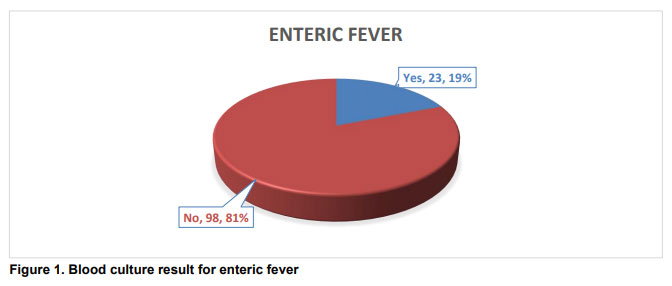
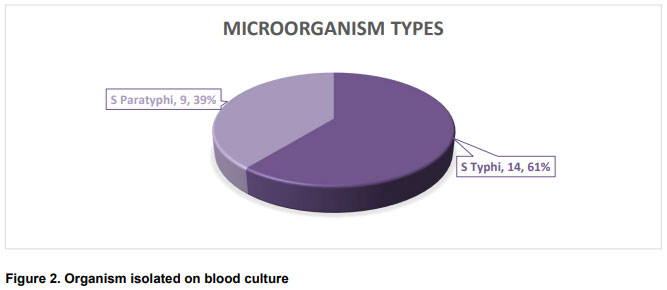
The mean age of the children was 6.60 ± 3.53 years, and 68 (56.2%) were male. The mean duration of fever at presentation was 5.45 ± 2.18 days, and the mean axillary temperature was 39.03 ± 0.60 °C. Blood culture was positive in 23 of 121 children (19.0%) and negative in 98 (81.0%) (Figure I). Among the positive cultures, S. Typhi was isolated in 14 (60.9%) and S. Paratyphi in 9 (39.1%) (Figure II).
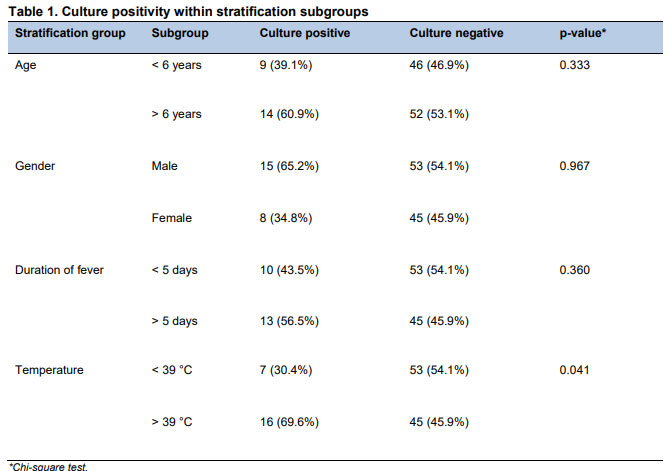
On stratification, the distribution of culture-positive cases did not differ significantly by age, gender, or duration of fever (all p > 0.05; Table I). Of the 23 positive cultures, 14 (60.9%) were in children older than six years and 9 (39.1%) in younger children (p = 0.333); 15 (65.2%) were male and 8 (34.8%) female (p = 0.967); and 13 (56.5%) had fever lasting more than five days, compared with 10 (43.5%) with a shorter duration (p = 0.360). Temperature showed a clear difference: 16 of the 23 positive cultures (69.6%) occurred in children with an axillary temperature above 39 °C, against 7 (30.4%) at or below this level (p = 0.041)
Discussion
This study set out to measure the frequency of blood culture–confirmed enteric fever in children presenting with acute febrile illness at our hospital. Almost one in five children (19.0%) had a positive culture, which confirms that the infection remains a major contributor to childhood febrile illness in our population. The figure lies within the higher range reported from South Asia. Ahmad et al. found a frequency of 25.2% in a comparable group,[11] whereas an Ethiopian study reported only 2.7% positivity [12]. Differences of this size reflect variation in geography, case selection, and sanitation. Our recruitment of admitted febrile children is likely to have raised the proportion seen here, and high rates in tertiary centres are consistent with active community transmission. Regional surveillance supports this, with the SEAP project placing the incidence in Pakistan among the highest reported [4, 6].
The mean age at presentation was 6.60 years, and most positive cases (60.9%) occurred in children older than six years, a pattern also seen in series from India, Pakistan, and Nepal [5, 13]. Wider environmental exposure once children begin school has been suggested as one contributor, but our study did not collect data on exposure setting, so this remains a hypothesis rather than a demonstrated link. A male predominance was present, as also reported by Qamar et al. and Baig et al., although no consistent biological explanation has been established [7, 14].
S. Typhi accounted for 60.9% of isolates and S. Paratyphi for the remainder. A substantial share of paratyphoid disease has been noted elsewhere; Qamar et al. reported that 31% of positive cases were S. Paratyphi A [14]. This distribution has practical importance, because the typhoid conjugate vaccines now used in endemic areas, including Pakistan, protect against S. Typhi but not against S. Paratyphi [1, 15]. Vaccination therefore needs to sit alongside basic measures such as safe water, sanitation, and hygiene, which remain central to control [12, 16]. On stratified analysis, children with a temperature above 39 °C were significantly more likely to have a positive culture (p = 0.041). This fits the expectation that higher fever reflects a greater chance of bacteraemia and a stronger systemic inflammatory response. Srinivasan et al. similarly found that higher temperature was an independent predictor of culture positivity (odds ratio 3.77) [17]. Where blood culture cannot be performed for every febrile child, a simple temperature threshold may help decide who should be tested first.
No association was found between culture positivity and age, gender, or duration of fever. The modest sample size limits the power to detect such associations, so these variables should not be read as reliable predictors on their own. This study did not include antimicrobial susceptibility testing, which is a notable gap given reports of extensively drug-resistant S. Typhi from Pakistan [6, 16, 18]. Local susceptibility data would have added value and would help shape treatment at our centre, and they should be a priority for future work.
Blood culture also has limited sensitivity, particularly when the bacterial load is low, the blood volume is small, or antibiotics have been taken beforehand [17]. The true frequency of disease is therefore likely to be higher than the culture-confirmed figure reported here.
This study has several limitations. It was conducted at a single centre with a modest sample size, and recruitment used non-probability consecutive sampling, which limits how far the results can be generalized. Susceptibility testing was not performed, treatment and outcome data were not collected, and the limited sensitivity of blood culture may have led to some under-detection. Larger multicenter studies that include susceptibility testing and a wider set of risk factors would give a clearer picture.
Conclusion
Culture-confirmed enteric fever was common among febrile children in this single-centre study (19.0%) and was associated with high-grade fever, a finding that may help direct blood culture testing where resources are limited. The notable proportion of S. Paratyphi cases points to a gap in current vaccine coverage. Given the single-centre design, modest sample size, and absence of susceptibility data, larger multicentre studies that include antimicrobial testing are needed to confirm these findings and to guide treatment.
References
- Manesh A, Meltzer E, Jin C, Britto C, Deodhar D, Radha S, et al. Typhoid and paratyphoid fever: a clinical seminar. J Travel Med. 2021;28(3). https://doi.org/10.1093/jtm/taab012
- Meiring JE, Shakya M, Khanam F, Voysey M, Phillips MT, Tonks S, et al. Burden of enteric fever at three urban sites in Africa and Asia: a multicentre population-based study. Lancet Glob Health. 2021;9(12):e1688-e96. https://doi.org/10.1016/S2214-109X(21)00370-3
- Pathak A, Upadhayay R, Mathur A, Rathi S, Lundborg CS. Incidence, clinical profile, and risk factors for serious bacterial infections in children hospitalized with fever in Ujjain, India. BMC Infect Dis. 2020;20(1):162. https://doi.org/10.1186/s12879-020-4890-6
- Garrett DO, Longley AT, Aiemjoy K, Yousafzai MT, Hemlock C, Yu AT, et al. Incidence of typhoid and paratyphoid fever in Bangladesh, Nepal, and Pakistan: results of the Surveillance for Enteric Fever in Asia Project. Lancet Glob Health. 2022;10(7):e978-e88. https://doi.org/10.1016/S2214-109X(22)00119-X
- Sinha B, Rongsen-Chandola T, Goyal N, Arya A, Kumar CM, Chakravarty A, et al. Incidence of Enteric Fever in a Pediatric Cohort in North India: Comparison with Estimates from 20 Years Earlier. J Infect Dis. 2021;224(Suppl 5):S558-S67. https://doi.org/10.1093/infdis/jiab046
- Yousafzai MT, Irfan S, Thobani RS, Kazi AM, Hotwani A, Memon AM, et al. Burden of Culture Confirmed Enteric Fever Cases in Karachi, Pakistan: Surveillance For Enteric Fever in Asia Project (SEAP), 2016-2019. Clin Infect Dis. 2020;71(Suppl 3):S214-S21. https://doi.org/10.1093/cid/ciaa1308
- Baig U, Mehdi SM, Iftikhar N. A pattern of antibiotic drug resistance of Salmonella Typhi and Salmonella Paratyphi among children with enteric fever in a tertiary care hospital in Lahore, Pakistan. Croat Med J. 2023;64(4):256-64. https://doi.org/10.3325/cmj.2023.64.256
- Andrews JR, Vaidya K, Saha S, Yousafzai MT, Hemlock C, Longley A, et al. Healthcare Utilization Patterns for Acute Febrile Illness in Bangladesh, Nepal, and Pakistan: Results from the Surveillance for Enteric Fever in Asia Project. Clin Infect Dis. 2020;71(Suppl 3):S248-S56. https://doi.org/10.1093/cid/ciaa1321
- McAteer J, Derado G, Hughes M, Bhatnagar A, Medalla F, Chatham-Stevens K, et al. Typhoid Fever in the US Pediatric Population, 1999-2015: Opportunities for Improvement. Clin Infect Dis. 2021;73(11):e4581-e89. https://doi.org/10.1093/cid/ciaa914
- Nusrat N, Islam MR, Paul N, Rahman N, Krishnapillai A, Haq MA, Haque M. Clinical and Laboratory Features of Enteric Fever in Children and Antibiotic Sensitivity Pattern in a Tertiary Care Hospital of a Low- and Middle-Income Country. Cureus. 2022;14(10):e30784. https://doi.org/10.7759/cureus.30784
- Ahmad M, Shah N, Siddiqui MA. Frequency and Antibiotics Sensitivity Pattern of Culture-Positive Salmonella Typhi in Children. J Coll Physicians Surg Pak. 2023;33(3):303-07. https://doi.org/10.29271/jcpsp.2023.03.303
- Deksissa T, Gebremedhin EZ. A cross-sectional study of enteric fever among febrile patients at Ambo hospital: prevalence, risk factors, comparison of Widal test and stool culture and antimicrobials susceptibility pattern of isolates. BMC Infect Dis. 2019;19(1):288. https://doi.org/10.1186/s12879-019-3917-3
- Chapagain RH, Adhikari S, Bhattarai T, Basaula Y, Bhattarai S. Burden of enteric fever and antibiotic sensitivity in Nepalese Children Prior to Typhoid Vaccine in National Immunization Program. J Nepal Health Res Counc. 2023;21(2):297-302. https://doi.org/10.33314/jnhrc.v21i02.4728
- Qamar FN, Yousafzai MT, Sultana S, Baig A, Shakoor S, Hirani F, et al. A Retrospective Study of Laboratory-Based Enteric Fever Surveillance, Pakistan, 2012-2014. J Infect Dis. 2018;218(suppl_4):S201-S05. https://doi.org/10.1093/infdis/jiy205
- Jayaprasad N, Borhade P, LeBoa C, Date K, Joshi S, Shimpi R, et al. Retrospective Review of Blood Culture-Confirmed Cases of Enteric Fever in Navi Mumbai, India: 2014-2018. Am J Trop Med Hyg. 2023;109(3):571-74. https://doi.org/10.4269/ajtmh.23-0102
- Memon H, Saeed F, Iqbal M, Saboohi E, Hanif S, Mallick AHH. Association of extensively drug resistant salmonella infection in children with typhoid fever. Pak J Med Sci. 2022;38(7):1864-69. https://doi.org/10.12669/pjms.38.7.5868
- Srinivasan M, Sindhu KN, Ramanujam K, Ramasamy RK, Subramaniam S, Ganesan SK, et al. Factors Predicting Blood Culture Positivity in Children With Enteric Fever. J Infect Dis. 2021;224(Suppl 5):S484-S93. https://doi.org/10.1093/infdis/jiab357
- Bibi S, Hussain Gilani SY, Siddiqui TS, Syed F, Arif MA, Haider N. Extensively Drug-Resistant Enteric Fever In Children: Surging Threats Of Antimicrobial Resistance And Possible Solutions. J Ayub Med Coll Abbottabad. 2023;35(3):424-27. https://doi.org/10.55519/JAMC-03-11769